How did you build Monite?
We bootstrapped for almost eight months, managing to build the MVP ourselves without significant expenses. Our initial product convinced early angel investors to support us. After additional months of bootstrapping, relying only on our savings, we recognized the insufficient resources to progress. So, we initiated our first fundraising campaign.
Our startup benefited from COVID a lot. Before 2020, investor relationships were all about those face-to-face meetings. But when the pandemic hit, everything changed. Zoom calls and e-signatures became the new standard, making funding decisions way quicker. We raised our first round of funding without having to physically be everywhere. Our location wasn't a deal-breaker anymore.
But, of course, fundraising also has its ups and downs. Ivan leveraged his network extensively, pitching our product to many angel investors. Yes, we got our fair share of rejections, but it's not about the 'no's, it's about that first 'yes.' Our persistence paid off when the first angel investor committed; soon enough, others hopped on board too.
These times marked one of the most challenging periods of my life, dealing with constant financial constraints and overwhelming workloads. However, overcoming these challenges has brought us to a point where we are scaling our company with top-notch professionals and expanding into significant markets such as the US and UK.
Which are your acquisition channels?
In the early days, we invested in networking, cold calling, and building our first sales team. We discovered that while these almost non-budget acquisition methods and experiments might show some results, relying solely on reputation and word-of-mouth referrals might not be enough to maintain a consistent flow of prospects in your sales pipeline.
Due to the complexity of the products, the involvement of multiple decision-makers on the client's side, and the experimental nature of market niches, it takes time for outbound B2B marketing to generate substantial revenue in the infrastructure business. Currently, the majority of our deals are successfully closed by our sales team, with fintech exhibitions serving as the second major source of customer acquisition for us.
This year, we've started diving into content-based marketing strategies. We're writing articles, jumping into podcasts, and doing interviews. While our content is gradually attracting new customers, it's important to remember that content marketing might need 1-3 years to kick in and bring in fresh leads. Now, we're confident that our marketing, led by a skilled CMO with previous experience at the market leader Mollie, will bring even more high-quality leads as the company establishes its market position and carves out its niche.
I think diving into marketing activities becomes a necessity at the moment you have a solid product ready to hit the market. Without investment in your solution, sustaining growth and expanding market reach can pose significant challenges. This is precisely when bringing a CMO on board can make a crucial difference, ensuring a strategic approach to marketing that aligns with the company's goals and propels it to the next level.
What are your goals for the future?
My overarching goal is to develop the ultimate set of API building blocks, empowering people to craft practical fintech applications without extra costs.
I believe an exceptional fintech company can be established with minimal financial resources in just a few months. Currently, the prolonged and expensive process deters talented innovators from venturing into the fintech industry.
What were the biggest challenges you faced and obstacles you overcame?
I see two primary challenges. Firstly, identifying and hiring top talent, particularly for early-stage companies, is exceptionally challenging. Exceptional talents uniquely blend hard and soft skills, making them rare and expensive to secure.
Secondly, fundraising is a tough game, so here's a key tip: be ready for lots of conversations with VCs. Many startups share that they talk to over 100 venture firms before sealing a deal. Interactions can be quick or involve multiple stages, like budget reviews and due diligence. VCs vary too—some get to the point, while others schedule lots of meetings, even if they won't invest.
Engaging with them, preparing data rooms, and developing financial models—all these tasks are draining and time-consuming. Moreover, securing funding is not only challenging but also entails the difficulty of raising investment from the right VC. And the rejection is part of the process; you might hear "No" multiple times, even after advanced discussions.
The founders should always remember that fundraising demands total commitment, often requiring them to step away from their daily responsibilities and dedicate 100% of their time to the process.
Which are your greatest disadvantages? What were your worst mistakes?
I've made two big mistakes. First, we messed up setting up our internal services in the company's microservice architecture. We ended up with too many, causing a headache of tangled connections and circular dependencies. It made our system super complex, making it tough to understand and manage.
Second, I let our tech teams have too much freedom without proper oversight. Initially, it gave us flexibility and speed but also led to chaos. After the first rounds of building our product, I started making sure everyone followed mandatory rules called Architecture Decision Records (ADRs). It helps our teams communicate better about significant tech changes and why we're making them.
If you had the chance to do things differently, what would you do?
I'd focus on getting customers early on. It's key for refining the product, getting feedback from the market, and gearing up for growth. Trying to expand without a product tested by real users isn't the way to go.
I'd also avoid working on features you can't sell to customers immediately. While some might seem cool, they can add unnecessary complexity too soon, which can slow down the speed of product development.
What are some sources for learning you would recommend for entrepreneurs who are just starting?
I'm picking up new skills by practicing them on purpose. The best way for me to learn was by working on personal projects and my first startup, even though it wasn't a big success. I've gone through all the classic startup books like "Lean Startup," "Crossing the Chasm," and "From 0 to 1." I tried applying their ideas in my projects, and I made almost every mistake in the book, but that's how I got better at building tech companies.
While reading books and listening to podcasts can be helpful, real hands-on experience is more crucial. Consuming content can make you feel like you're learning something important, but you're not moving forward if you're not working on your ideas. I cut down on my startup and business books, focusing more on hardcore software engineering, math, psychology, and finance management.
And there's this one book about startups that really stood out for me: "The Personal MBA" by Josh Kaufman.
Where can we go to learn more?
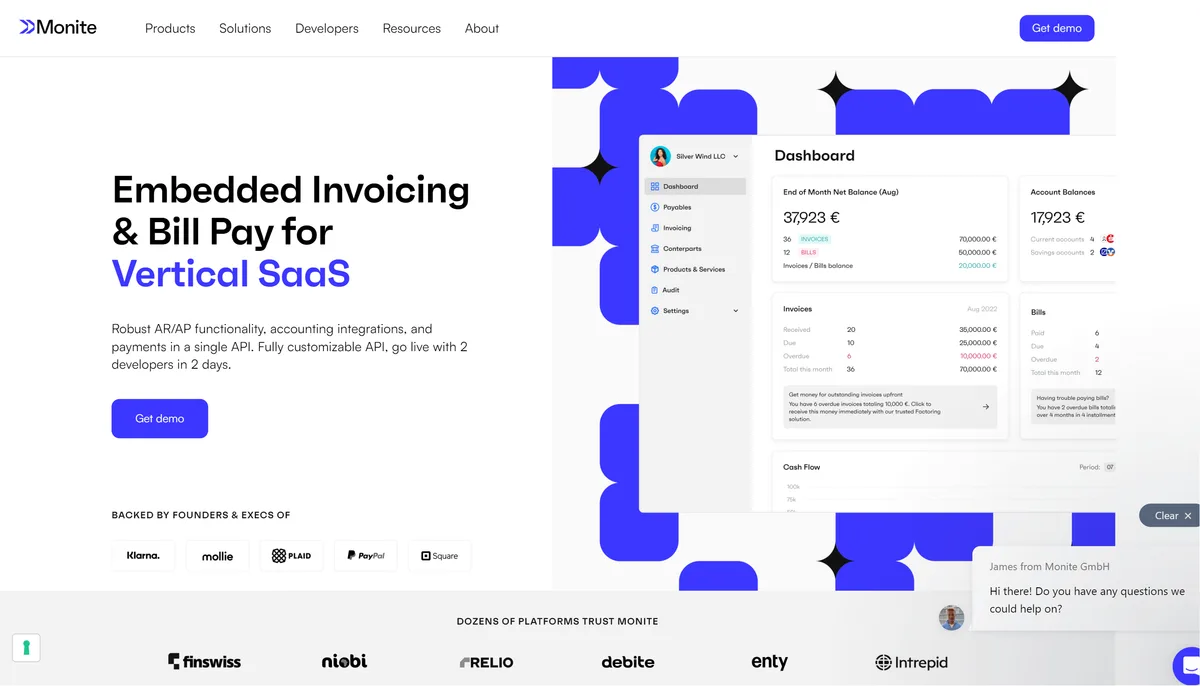
To better understand what Monite is working on, visit our company's website. Additionally, explore our detailed guides on accounts payable and accounts receivable automation, offering valuable insights into why B2B companies opt for embedded workflows to enhance their earnings from clients.
We've also just introduced our tech-focused blog on Dev.to. Our tech team shares their thoughts on engineering challenges, product management, software design, and other tech-related topics. I post brief updates on my LinkedIn, discussing the progress we're making and sharing personal management and startup experience. Feel free to reach out to say hi and ask any questions about the founder's journey.
As for other sources of inspiration, I highly recommend reaching out to an experienced founder for mentorship. It's also a good idea to connect with seasoned angel investors who regularly observe various early-stage companies and are familiar with common challenges. Most big cities have communities of angel investors; these folks are usually pretty chatty and willing to help. Just Google things like 'YOUR_CITY_NAME (or YOUR_COUNTRY_NAME) angel syndicate, and you'll likely find something.
If you come across some early-stage startups you admire, don't be shy about dropping the founders a message and asking a few questions. Not everyone will reply, but those who do can provide you with some valuable information.